

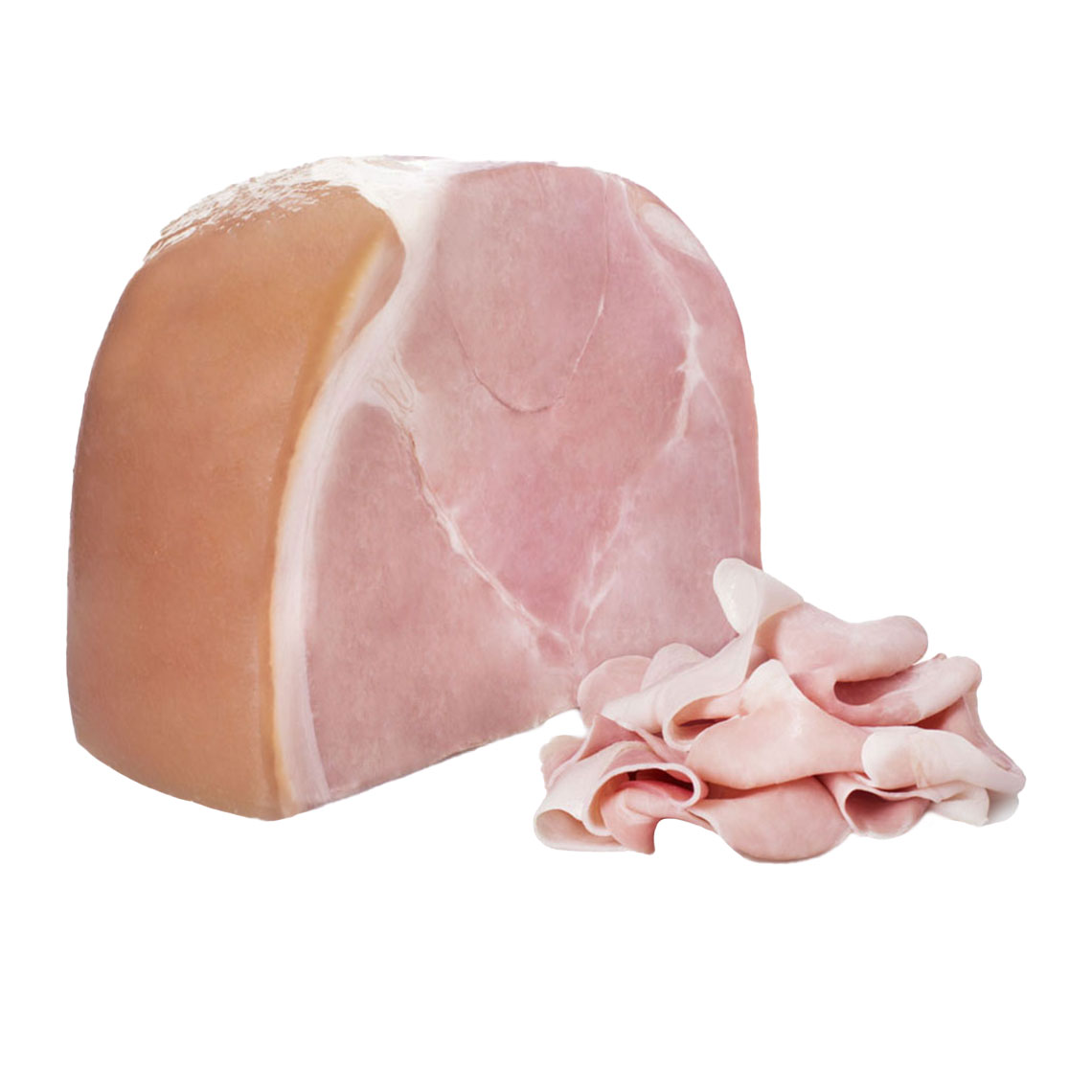
HOW TO ENJOY IT BEST According to Italian Law, there are three different categories of Cooked Ham, whose difference depends on both the production and sale of this cured meat throughout Italy: High-quality Cooked Ham: to be included in this category at least three of the four main leg muscles must be identifiable. In addition, the humidity rate must range between 75.5% and 76.5%. Selected Cooked Ham: in this case also, at least three of the four main leg muscles must be identifiable but the humidity rate must range between 78.5 % and 79.5 %. Cooked Ham: is made from the leg and the humidity range goes from 81% to 82%. Prosciutto Cotto is a type of cooked, non-stuffed partly covered with rind Ham. The processing it undergoes gives it a scented delicate flavour. It can be tasted in many ways: cut into cubes or slices for an aperitif; as a filling for a sandwich or for many creative dishes. Get inspired by all the ideas to prepare it in the recipe section of our website! But what about the right pairing? To enhance the unique flavour of this delicious ham, we recommend enjoying it with some dry fresh white wine with a moderately savoury and smooth taste such as Vernaccia di San Gimignano DOCG. PROCESSING STEPS Cott Cooked Ham is produced from selected Italian pork meat flavoured with natural aromas and selected spices that give it its unique flavour. The production of Cott Cooked Ham includes very specific steps. The leg is deboned and massaged for a few days. Next, it undergoes salting which, unlike other cured meats whose seasoning is applied on the surface, in this case, is inserted directly inside so that the meat absorbs it uniformly. Then the churning process takes place: the meat is slowly massaged for up to 70 hours. The following steps are steam-oven cooking, cooling and hulling to shape and clean the surface. Finally, the moulds are placed in an aluminium bag and pasteurised. HISTORICAL NOTES Cooked Ham has very ancient origins, probably dating back to ancient Rome. Although it is considered a type of cured meat, Cooked Ham is similar to ‘large roasts’. Its discovery, therefore, can be attributed to the peoples of the northern regions of the Roman Empire who tried to eat the leg after boiling and flavouring it with herbs. It is possible that the legionaries acquired the knowledge for the preparation of cooked ham from the conquered barbarian populations, such as the Gauls or the Lombards. It is no coincidence that the regions that produce the best Cooked Ham, given their long history of tradition, are Lombardy, Liguria, Piedmont, Emilia-Romagna and Friuli Venezia Giulia.
Related Products
Blog Detail
Sort by
Show